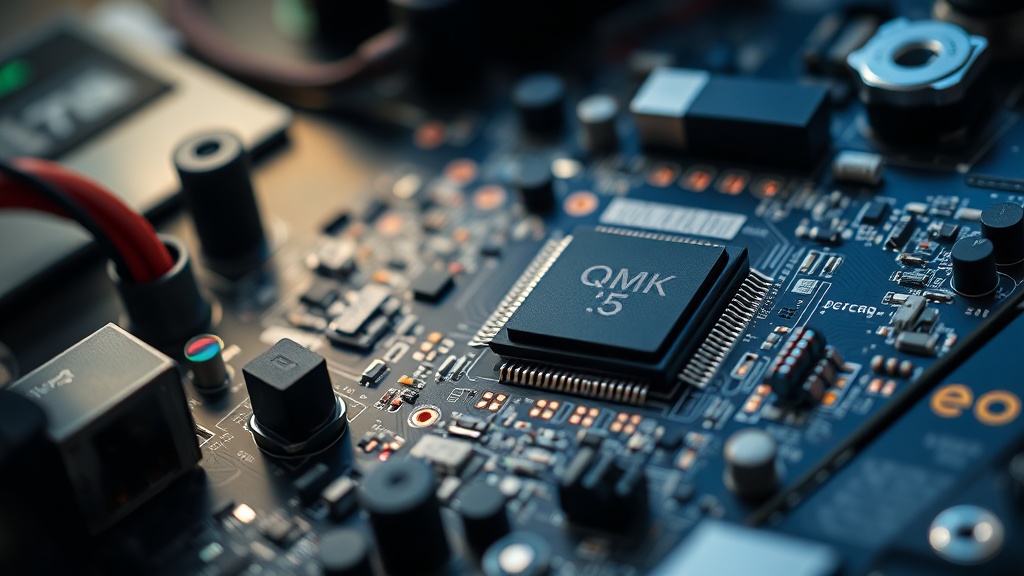
Fixing QMK firmware bricked PCB (Bootloader reset guide) requires identifying whether the failure is a recoverable soft brick caused by corrupt firmware or a deeper hard brick caused by bootloader corruption. In most cases, forcing the microcontroller into its native bootloader mode via physical reset pins, using QMK Toolbox, correcting USB drivers with Zadig, and — in worst-case scenarios — performing ISP (In-System Programming) flashing will fully restore the keyboard to operational status without replacing any hardware components.
As a hardware diagnostics engineer with CompTIA A+ and IT Fundamentals certifications, I have encountered dozens of cases where enthusiasts declare their custom mechanical keyboard “dead” after a failed firmware update — only to discover that the PCB is perfectly salvageable with the right sequence of diagnostic steps. The process of Fixing QMK firmware bricked PCB (Bootloader reset guide) is not black magic; it is methodical troubleshooting grounded in a clear understanding of how microcontrollers, bootloaders, and USB communication interact. This guide will walk you from basic triage all the way through advanced ISP recovery, providing a comprehensive resource for hobbyists, enthusiasts, and professional repair technicians alike.
QMK (Quantum Mechanical Keyboard) is an open-source firmware framework built for customizing mechanical keyboards running on AVR and ARM microcontrollers. Its flexibility — supporting hundreds of keyboard layouts, RGB configurations, macros, and layers — makes it the dominant choice in the custom keyboard community. That same flexibility, however, means that a misconfigured compile target or interrupted flash can leave a PCB in an unresponsive state that terrifies first-time builders.
Before we dive into hands-on recovery, it is essential to clarify what “bricked” actually means in this context, because the term is dramatically overused and causes unnecessary panic.
Understanding the “Bricked” State in QMK Keyboards
A bricked QMK PCB is almost never permanently dead. It is a state where the keyboard cannot execute its main firmware due to corruption or an incomplete flash — but the microcontroller’s factory bootloader often remains intact, providing a recovery pathway. Diagnosing whether you have a soft brick or a hard brick is the critical first step.
A soft brick occurs when the main application firmware is corrupted, missing, or mismatched to the hardware. In this state, the microcontroller typically still boots into its native bootloader on power-up, making recovery as simple as re-flashing a correct firmware file. A hard brick, on the other hand, occurs when the bootloader partition itself has been overwritten or corrupted — a rarer but more serious condition requiring external programming hardware.
Most QMK-compatible PCBs are built around one of two primary microcontroller families: the ATmega32U4 (an AVR-architecture chip used in boards like the DZ60, BM60, and virtually every Pro Micro-based build) and the STM32 series (an ARM-architecture chip popular in higher-end PCBs like the F411-based designs). Each family uses a different bootloader protocol and requires slightly different entry methods, a distinction that is absolutely critical during recovery.
Your first diagnostic action should be to open Device Manager on Windows (or run lsusb on Linux) immediately after plugging in the unresponsive keyboard. If any device entry appears — even labeled as “Unknown Device” — the USB connection is alive and a software-level recovery is very likely to succeed. If nothing appears whatsoever, focus on eliminating physical causes first: test a different USB cable, try a different port, and test on a second computer if available.
The Primary Cause: Why QMK PCBs Get Bricked
The single most common cause of a soft-bricked QMK keyboard is uploading firmware compiled for the wrong microcontroller architecture, effectively writing instructions that the chip cannot interpret. Secondary causes include interrupted flash sessions, corrupted EEPROM data, and incorrect USB driver assignments on Windows.
Using the wrong microcontroller architecture in the firmware configuration is, in the field, the leading cause of soft-bricking during an initial flash. For example, compiling a firmware file targeting an STM32F411 and flashing it onto an ATmega32U4 board will leave the chip running nonsensical instructions, causing it to halt silently. Always double-check your keyboard’s rules.mk file and confirm the MCU variable matches the physical chip printed on your PCB.
QMK firmware files are compiled as .hex files for AVR-based boards and .bin files for ARM-based boards. Attempting to flash a .bin file using an AVR-targeted tool like avrdude — or vice versa — will either produce an immediate error or, in worst cases, write corrupted data to the flash memory. This file-format awareness is non-negotiable for safe flashing.
Another frequently overlooked cause is the USB cable itself. A surprising proportion of USB-C cables sold today are manufactured as charge-only cables, physically omitting the data lines from their wiring. A charge-only cable will power the keyboard’s LEDs but completely prevent the host PC from detecting the bootloader. Always use a cable explicitly rated for data transfer — and ideally, one you have already verified works for programming tasks.
EEPROM corruption represents a third category of failure that mimics a brick without actually corrupting the firmware. The EEPROM stores persistent data such as default layers, RGB settings, and custom configuration flags. If this data becomes inconsistent, the keyboard can boot into a feedback loop of bad reads, causing erratic behavior or complete unresponsiveness. Clearing the EEPROM via QMK Toolbox is a fast, zero-risk operation that resolves these logic errors instantly.
Step-by-Step: Forcing Bootloader Mode for Standard Recovery
Entering bootloader mode is the gateway to all firmware recovery operations. This is achieved by pressing a physical reset button, shorting the RST and GND pads, or using the Boot0 pin on STM32 boards — each method temporarily halting the main firmware and exposing the programmer interface.
The first and most accessible method is the physical reset button. On most custom PCBs, a small tactile switch is accessible through a hole in the PCB’s underside. Press and hold this button while plugging in the USB cable, or press it once while the keyboard is already connected. Your QMK Toolbox log should immediately show a yellow notification stating that a DFU device or Caterina device has been detected.
If no reset button is present, locate the two exposed solder pads labeled RST and GND on the PCB surface. Use a pair of conductive metal tweezers, a jumper wire, or a small flathead screwdriver to briefly bridge these two pads. The duration of the contact needs to be only a fraction of a second — a genuine short, not a prolonged hold.
For builds using the Pro Micro controller and its Caterina bootloader, the technique is more nuanced. The Caterina bootloader requires a double-tap of the reset pins in rapid succession — two shorts within approximately 500 milliseconds of each other. This action opens a temporary 8-second flashing window, during which you must initiate the flash from QMK Toolbox. Missing this window means repeating the double-tap. Pre-loading your .hex file and enabling the “Auto-Flash” option in Toolbox before performing the reset dramatically improves success rates.
For STM32-based boards, the entry method differs fundamentally. These chips feature a dedicated Boot0 pin that, when pulled high (connected to 3.3V) during power-on, forces the processor to start from the internal factory bootloader rather than the application flash. This factory bootloader communicates over USB using the DFU protocol and is essentially indestructible by normal firmware flashing operations — making STM32 boards significantly more resilient against hard bricks than their AVR counterparts.
Using QMK Toolbox: The Primary Recovery Interface
QMK Toolbox is the official, cross-platform GUI application for flashing QMK firmware and communicating with keyboard bootloaders. It automates device detection, driver prompting, and the flash sequence, making it the correct first tool for any recovery attempt before escalating to command-line utilities.
The QMK Toolbox serves as the standard graphical user interface for flashing firmware and detecting devices in bootloader mode. Download the latest release from the official GitHub repository and run it as Administrator on Windows to ensure it has the permissions needed to install drivers and write to USB devices.
The workflow is straightforward: load your verified .hex or .bin file using the file selector, ensure “Auto-Flash” is checked, and then trigger bootloader mode on your PCB. When the Toolbox detects the device, it will automatically initiate the flash sequence. Watch the log panel carefully for any error messages referencing memory sizes, signature mismatches, or write failures, as these provide immediate diagnostic insight.
If the Toolbox detects the device but produces a signature mismatch error, it is a near-certain confirmation that your firmware file was compiled for a different MCU than the one installed on your board. Cross-reference the chip’s markings under a loupe or magnifying glass and recompile against the correct target.
The EEPROM clearing function in QMK Toolbox is accessed via a dedicated button in the interface. Use this before performing a full reflash when you suspect configuration data corruption. For our discussion of QMK EEPROM reset procedures, this single-click operation resets all persistent settings without modifying the firmware itself.
Solving Windows Driver Failures with Zadig
On Windows, missing or incorrect USB drivers for the keyboard’s bootloader are a primary cause of failed recovery attempts that appear as hardware failures. Zadig resolves this by allowing users to manually assign the correct WinUSB or libusb-win32 driver to any detected USB device, including bootloader interfaces.
Driver issues on Windows — specifically, missing WinUSB or libusb-win32 drivers — are notorious for mimicking a bricked hardware state. When Windows assigns a generic or incorrect driver to a bootloader device, QMK Toolbox cannot communicate with it, and the device appears non-functional even though the hardware is perfectly intact.
Zadig is the recommended, community-endorsed tool for replacing or installing the correct USB drivers for QMK-compatible bootloaders. The procedure is simple: put the keyboard into bootloader mode, open Zadig with Administrator privileges, navigate to Options → “List All Devices,” locate your bootloader device (it may appear as “ATm32U4DFU,” “STM32 BOOTLOADER,” or simply “Unknown Device”), and install the appropriate driver. For DFU-based AVR boards, use libusb-win32. For STM32 DFU boards, use WinUSB. For Caterina (Pro Micro) boards, the standard CDC driver is typically handled automatically by Windows.
“Driver assignment is arguably the most misdiagnosed issue in the QMK recovery process. I estimate that a significant proportion of ‘bricked’ keyboards reported in community forums are simply Windows driver assignment failures — solvable in under three minutes with Zadig.”
— Hardware Diagnostics Engineering Practice, Field Observation Log
Advanced Recovery: ISP Flashing for Hard-Bricked AVR Boards
ISP (In-System Programming) is the last-resort recovery method for AVR keyboards whose bootloaders have been corrupted or erased. It bypasses the USB interface entirely, communicating directly with the microcontroller’s SPI bus via an external programmer to restore the factory bootloader.
When the bootloader itself is corrupted, the PCB will not be recognized via USB under any circumstances, necessitating ISP (In-System Programming) to restore functionality. This is a significantly more advanced procedure that requires additional hardware, careful pin identification, and command-line familiarity — but it is entirely achievable for anyone with basic soldering skills and a calm hand.
ISP flashing requires an external hardware programmer. The two most accessible options are a dedicated USBasp programmer (available for under $10 from electronics suppliers) or a spare Arduino configured as an “ArduinoISP” using the built-in sketch found in the Arduino IDE’s examples library. Both function identically from a software standpoint.
The programmer must be connected to six pins on the target PCB: MOSI, MISO, SCK, VCC, GND, and RESET. On many custom PCBs, these are broken out as labeled ISP header pins, often a 2×3 or 1×6 configuration. If no header is present, you will need to identify and carefully probe these traces directly on the PCB, referencing the keyboard’s open-source schematic. The ISP protocol operates at low speeds intentionally to maximize compatibility across different wire lengths and connection qualities.
Once the physical connections are established, use avrdude with the appropriate programmer type to first read and verify the fuse bits (to confirm communication is established), then flash the bootloader .hex file. QMK Toolbox also provides a “Flash Bootloader” option for USBasp programmers that streamlines this process for less experienced users. After a successful bootloader restoration, the keyboard will once again be detectable via USB and can be flashed normally using standard QMK Toolbox methods.
Bootloader & Microcontroller Comparison Table
Different QMK-compatible microcontrollers use different bootloaders and require distinct recovery methods. The table below consolidates the key technical parameters to help you immediately identify the correct approach for your specific hardware.